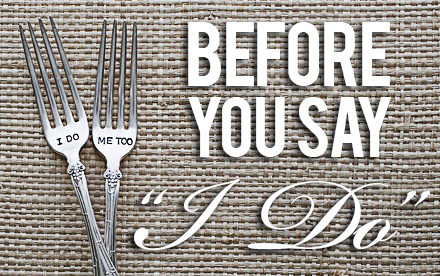
BEFORE YOU SAY, “I DO”.

It was Saturday morning and as I dressed up to attend Yeni’s wedding to Ibidapo, I felt joy well up inside of me. Ibidapo had lost his darling mother, (my friend, Lily) a couple of years ago and I had more or less monitored his progress. In the past one and a half years I had witnessed the emerging relationship between the love birds and felt Yeni was a perfect match for Ibidapo, so I would not miss this wedding for anything.  I quickly put the church address on my Google Maps application and navigated my way to the new Pentecostal church on the other side of town from me, where the ceremony was slated.

I was comfortably seated and enjoying the service when the vows taken by Yeni caught my attention. I initially thought I had heard wrong, so I listened intently. She had said, “I Yeni do take you Ibidapo to be my wedded husband, to have and to hold,  for better for us, for richer for richest, in wellness and health, till death do us part.” I was nonplussed but quickly composed myself until I had the opportunity to voice my curiosity at the reception when I sat next to a couple –  Jonas and Mildred Wilcox, who were members of the same church. After the usual courtesies and small talk, I raised the issue of the marriage vows which I considered unusual. I had been used to the conventional …” For better for worse, for richer for poorer, in sickness and in health…”

Mildred was the first to respond and she gave two reasons to justify the deviation from the norm. She explained as follows and I quote:

  1. “Marriage vows are not biblical but arose out of church tradition which means the traditional vows are not sacrosanct. Consequently, they can be modified especially since their church does not frown upon such modification. Moreso, persons of other faiths and civil marriages do not necessarily make such vows.
  2. The bible states in Proverbs 18.21 that life and death are in the power of the tongue. It is therefore important to confess positively into your life. Why call forth poverty, sickness, and negative challenges into your life? A positive confession makes such come alive.”

Jonas then concluded “Vows are serious utterances that must not be taken lightly. Ecclesiastes 5.5 states clearly that there are repercussions for making a vow and not fulfilling it. It says it is better not to vow than to make a vow and not fulfill it. Jesus Christ re-echoed this Old Testament teaching in Matt.5.22. That does not mean the couple will not stick through thick and thin with each other but why invite negativity into the relationship? Furthermore, if for any reason one of them decides to leave in a time of adversity, they may feel bound by the vow taken.”

Havilah however believes that the Traditional vow is practical and helps the couple to endure the times of adversity and enjoy the times of prosperity.  Life comes with its challenges over time and the vow is merely indicative of a willingness to remain by each other’s side regardless of the challenges that may be faced. It merely implies that through all the changing scenes of life, the couple will co-operate with each other to overcome. While it is possible that without taking such a vow, the couple is prepared to navigate challenges together and stick with one another, they must be mindful of the implications of whatever vow is made. As Jonas explained, vows must not be trivialised as the bible clearly states it is better not to make one than to default in its execution.

So…before you say” I do”, give some thought to the Marriage vows you intend to make and the possible implications. May the Lord grant each one the ability to fulfill their vows.

Love

Havilah

UNDERMINING THE PERIOD OF THE “EMPTY NEST”

Listening to a podcast today where the influencer stressed the importance of preparing for old age, I realised that the significance of preparing for the “empty nest” as part of preparations for old age, is often undermined. However, experience has shown that family relationship requires as much investment as financial and self-care, in ensuring a satisfying old age. Let us contrast two families known to me.

The Harry family is one in which all three children have” fled the coop.” Two are married and settled abroad, while the third, though single, lives in a rented apartment in the same city with his parents. Each time I visit, Mama Harry is hardly home, traveling, visiting the children or other family members if not at one function or the other. Papa Harry is usually left at home in the hands of his caregiver, with little or no social interaction.

On one of the occasions, I was able to pin Mama down and subtly hint that Papa pines for his family, and that they should spend more time around him or arrange for him to visit. She took a deep breath and responded, “Thank you, my dear. It is a predicament my husband brought on himself. In his younger days, he neglected to invest either time and/or finances in the family. All my entreaties were ignored as he was always out of the home in the company of friends. He considered himself a socialite so invested in his social circle. In addition, he subjected me to emotional abuse which was visible to the children and other persons who lived with us. All my attempts to make him see reason were rebuffed, and I recall saying, I hope his friends will be there for him in his old age. He practically ostracised himself from his children’s development by his actions and so it came as no surprise that when the children could afford to, they moved out. I have since forgiven him, but he needs to forgive himself and make reconciliatory moves towards his children. He missed the opportunity to bond with his family when he should have, forgetting that a time like this is bound to happen.”

 I heaved a deep sigh and promised to encourage Papa to make the reconciliatory move to enable him to have peace before his passing.

On the other hand, the Johnson family is so blest. Anytime I visit Mama and Papa Johnson, they are together. They do practically everything together and you can see the radiant glow on their faces and feel the warmth around them. In their case, all four children are abroad spread out in separate locations, but they jointly care for their parents. They visit together, take walks together, travel together, and do everything in unison. If at any event you see one before the other, rest assured the partner is close by. I was intrigued by the level of cooperation they share and when I approached Mama, she had this to say. “It feels great that after so many years of sharing my husband with the children, work, and others, I have him all to myself again. We started life together before the children came along, and as the phases came, he always found time to invest time, finances, and prayers in his family. He is a good man and deserves all the love, happiness, and care we can give him. He never shirked his responsibilities even when we went through some challenging times. I intend to be by his side till death do us part.”

My encounter with both Mamas left a distinct understanding of the idiomatic expression “As you lay your bed so shall you lie on it.” Much as I feel for Papa Harry and believe there is a place for forgiveness, it is important for all to realise that investing in the family forms an important part of preparing for old age.

It should also be noted that this applies to both mothers and fathers alike as some women abandoned their homes and children but ended up lonely and bitter, wishing they had done things differently. One must not frustrate the likelihood of companionship in old age. The impact of loneliness in old age can be crippling.

Love

Havilah

CROSS-DRESSING – A SIGN OF THE TIMES?

I was at a hairdressing salon recently and the topical discussion centered on a notorious cross-dresser who happens to be a” social media influencer.” As the debate about his/her activities and the social impact raged, several questions preyed on my mind. I intend to share them with you here with the hope of us addressing our mind to the full implications of encouraging such persons in our society.

Who is a Crossdresser, and does s/he differ from the age-old Transvestite?

Is Crossdressing merely a fad or does it affect the person’s psyche such that he/she believes they are members of a different sex?

Do cross-dressers get married and if yes, is the partner the same sex or a different sex?

Is a cross-dresser necessarily a gay person?

How did they get there? Were certain childhood experiences responsible and did they exhibit such preferences in childhood?

What is their relationship with their parents, siblings, and extended family?

How have their choices impacted their family in their communities/environment?

We usually discuss male cross-dressers, are there female cross-dressers and if yes, why are they less visible?

So, what precisely is Cross Dressing? The MSD Manual (Consumer Version) carries an article by George R. Brown, MD, East Tennessee State University from which I extract the following excerpts.

“Most cross-dressers do not have a Psychiatric disorder. They may be said to have transvestism. In transvestism (cross-dressing), men prefer to wear women’s clothing, or, far less commonly, women prefer to wear men’s clothing. This may be because women have a broader range of apparel considered consistent with gender. However, they do not have an inner sense of belonging to the opposite sex or wish to change their sex. The term cross-dressers is usually used to refer to people with transvestism. Transvestite is a less acceptable term and is considered offensive. Cross-dressing in and of itself is not considered a mental health disorder. Cross-dressing occurs in both heterosexual and homosexual men, and much more uncommonly in women. Nonbinary people who dress in clothing typically associated with a different birth sex are generally not engaging in “cross-dressing” for the purposes of sexual arousal. They probably associate themselves with the opposite sex.

Heterosexual males who dress in women’s clothing typically begin such behavior in late childhood. This behavior is associated, at least initially, with intense sexual arousal.

Cross-dressers may, however, cross-dress for reasons other than sexual stimulation—for example, to reduce anxiety, to relax, or, in the case of male cross-dressers, to experiment with the feminine side of their otherwise male personalities.

Later in life (sometimes in their 50s or 60s), some men who were cross-dressers only in their teens and twenties develop gender dysphoria. They may seek to change their body through hormones and genital (gender-affirming) surgery.

When a partner is cooperative, cross-dressing may not hurt a couple’s sexual relationship. In such cases, cross-dressing men may engage in sexual activity in partial or full feminine attire with the consent of their partner.

When a partner is not cooperative, cross-dressers may feel anxious, depressed, guilty, and ashamed about their desire to cross-dress. In response to these feelings, these men often purge their wardrobe of female clothing. This purging may be followed by additional cycles of accumulating female clothes, wigs, and makeup, with more feelings of guilt and shame, followed by more purges”.

While the above may not adequately address all our questions, it gives some insight about Cross-dressers and stimulates our thoughts. Unfortunately, social media serves as a sphere of influence over our youth and there is so much exposure regarding cross–dressing. There is also a growing fad for men to wear jewelry, braid their hair, etc while ladies wear masculine cuts. This in itself does not amount to cross-dressing…what do we think?

Love

Havilah

IS” TOUGH LOVE” APPLICABLE TO MARRIAGE?

Quite often when the term “tough love” is used, one tends to associate it with disciplining youth and adolescents. The ability to leave them to suffer the consequences of their action enables them to learn from experience. However, I recently attended a symposium on TOUGH LOVE IN RELATIONSHIPS. Incidentally, I arrived about an hour early, so I had the opportunity to engage three other ladies who were also early birds.

Mazino, a comely soft-spoken lady in her early fifties, spilled her story. She had married her husband at a time when she had a comfortable business while the husband was straight out of school and earned an income that barely took him home. Because of her kind and considerate nature, she agreed to take on most of the expenses at home with the hope that when his finances improved, he would take on the mantle of responsibility. Subsequently, entreaties/threats to take on some of the financial burden, especially after the birth of their children, were ignored. His money was his own while hers was for their collective upkeep and advancement. With extra money in his hands at his disposal, he soon resorted to a careless lifestyle that cost him his job. That was the beginning of his downward plunge into depression and substance abuse resulting in higher levels of irresponsibility and deeper cycles of depression. Mazino was at her wit’s end having accepted her lot to be the provider for the family, but she felt a need to help him redeem his self-esteem and she loved him too much to watch the spiraling decline. One day, while pouring out her heart to Ejiro who was calmy seated beside her, she had suggested that she should have applied tough love. In her view, she had been too understanding thereby enabling his behaviour. In her opinion, a tougher stance in addition to the prayers she had continually rendered, may have produced results. As she rounded up, Ejiro continued:

“In my case, I made it clear from day one that certain boundaries must be observed. Regardless of how it was funded, (beg, borrow, or steal) my husband had to be responsible for our accommodation, children’s school fees, and part funding of upkeep. I helped with other things as needed but never took on his agreed responsibilities. It has worked for us, and I feel that is a form of tough love. I fashioned him to be responsible. I believe Mazino treated her husband like a spoilt child which encouraged his lethargy. Anyway, that is why I dragged her to this symposium to expose her to the experiences of some other women and help her fashion out how her situation can be remedied”.

A few minutes later, the symposium started, and the discussions were very instructive on the topic as life experiences were shared in expounding the topic. Tough love was described as a subtle and dynamic approach to relationships, challenging conventional notions. You must be prepared to make tough decisions, set boundaries, and give honest feedback to address underlying issues. While it seems to contradict our perception of tenderness associated with love, it focuses on the long-term goal of growth and strength. It creates a balance between being caring and compassionate yet firm and assertive. For instance, in dealing with substance abuse, one must take a firm stance, set boundaries, and refuse to enable or tolerate the destructive behavior any longer. (A sideward glance at Mazino showed she was lapping up every word). One may refuse to be around when the abuse happens or seek support or help. It was however stressed that Tough Love should not be targeted at neglecting or hurting the partner by belittling them or displaying rudeness.

Tough Love comprises the following:

  1. Setting boundaries highlighting expectations and limits that must be shared with the partner.
  2. Being honest and open about concerns, expectations, and issues to be addressed.
  3. Focusing on the unacceptable behavior, not attacking character.
  4. Being firm yet compassionate and caring.
  5. Allowing the partner to face the consequences of their action.
  6. Encouraging personal responsibility and hold them accountable for their actions and decisions. No excuses.
  7. Allowing them to fashion out their own solutions and learn from experience. Offer them support…not solutions.
  8. Being consistent, sticking to your boundaries and expectations so as not to present a confused signal.
  9. Seeking external help from counselors or therapists where necessary!
  10. Importantly, indulging yourself in self-care and ensure your well-being.

Needless to say, Mazino left the symposium relieved after fixing an appointment to consult with one of the therapists who facilitated.

Love

Havilah

BUILDING HARMONY OUT OF DISCORD

Ogbealu had just laid her mother to rest with an immensely befitting burial. Mama’s three children – Chike, Ufuoma, and Ogbealu (all of whom are accomplished and successful in their various fields of endeavour) had pulled resources together to give her a resounding burial. The cooperation and unity displayed by the trio in events leading to and during the interment of their mother – Mama Chike as she was fondly called, was not just commendable, it was palpable. It was the talk of the town. As she sat down to review the consolidated accounts of her restaurant chain, in walked her friend and colleague Fumbi. Fumbi ran a phenomenally successful catering outfit and had been part of the burial arrangements, Fumbi plonked her bag onto a chair, and could not hide her curiosity as to how Mama Chike’s children had achieved that level of collaboration that was glaring to all.

Fumbi started “Lulu, the unity and constructive collaboration displayed were incredible! You know, my only sibling, Simbo, and I can barely put up appearances when we must come together on any project. She was the egghead when we were growing up. Our parents’ golden girl. Whatever I did never measured up even though I was far better at domestic chores and cooking came to me naturally. My mother especially, never had any word of praise, it was always… “Fumbi, you will be lucky to end up as a successful street food vendor (a local mama put).” Simbo went on to get a prime job after university while I struggled to earn a living doing minor catering contracts and this continued for a while until, the multinational company at which Simbo worked packed up and left the country. It was a major catastrophe for Simbo who had to solicit my assistance until things picked up for her again. Whenever she approached me, I would remember the taunting during my difficult years and never failed to remind her that I was meant to be a street food vendor. I would gloat over her misfortune before rendering the needed help. Needless to say, she has since picked up the pieces and is doing well but there is a gaping gap in our relationship, we both know, and we are just putting up appearances when we deem it necessary.”

Ogbealu set down the books she was tallying and took a deep breath. “Fumbi, how can you guys live with such unnecessary baggage? In our home, Chike was our Einstein and went on to do well in Investment banking and Financial Services. Our mother however believed that every child has a gift and recognised mine and Ufuoma to be in the area of culinary and fashion respectively and she encouraged us to follow our passion and be the best we could. Needless to say, we had no excuse to envy each other as Ufuoma’s clothing label is going places now. Chike has also been of tremendous help to us both (Ufuoma and I) as we have leveraged him for financial backing to grow our businesses as well as investment advice. We have been able to work as a team to our mutual benefit on most projects.”

“My dear friend,” she continued, “you need to eat humble pie and apologise to your sister for the way you treated her in her time of need. After all, God has been good to you and has elevated you. Bitterness is a cancer that spreads and destroys everything. Do not allow it to fester in your heart. Find a place to forgive your parents and do not forget it was not your sister’s fault that she has the brains. God has endowed everyone with what they need to take them to where he has planned for them and because his plans for us are good, let us trust him and thank him for where he leads us.”

Havilah shares Ogbealu’s sentiments and wishes to add that often sibling rivalry is promoted by the handling of parents. We must all remember that  God created us all differently so that we can complement each other and that is the only way objectives can be realised. There is nobody created that is worthless. We must therefore learn to appreciate one another and look out for the merits of everyone. May the Lord help us all.

Love

Havilah