THE SCOURGE OF PASSION MURDERS

Edwina was a young, pretty and intelligent girl of nineteen, who passed her Secondary School Certificate with flying colours but could not continue her education as a result of a lack of sponsorship. Her parents were farmers in the village and Edwina was constrained to assist them in their palm oil trade. That December, Ikemefuna, a young man from their town who lived “in the abroad” as he was often described, came home (to the village) to celebrate Christmas and ran into Edwina who was running an errand for her father, it was love at first sight.

First, a few words about Ikemefuna: he was a young man in his late thirties who had left his town in search of greener pastures “in the abroad” some seven years before. He had done odd jobs, married a citizen, had a daughter, and had recently divorced his wife. He had come home for the Christmas celebrations with the primary motive of searching for a wife.  Immediately he set his eyes on Edwina, he decided…this is SHE! He proposed to her and shortly after the traditional marriage rites were performed and Edwina became Ikemefuna’s wife. However, in her naivety, Edwina omitted to inquire more deeply about her husband but was both excited at being married and more importantly, at the prospects of travel.

After about a year, all immigration formalities concluded, Edwina was able to join her husband who having recognised her promise, worked hard to sponsor her education. Edwina studied programming and ended up in one of the “Tech” companies where she quickly ascended the corporate ladder. She was earning mega dollars while Ikemefuna was still doing odd jobs to make a living for his family. Initially, Edwina would fund the joint account with Ikemefuna for the family’s expenses but after a while, her tastes and expectations were different, and she furnished a lavish lifestyle from a different personal account. All attempts to restrain Edwina and maintain his authority as head of his home which now comprised two sons and his daughter from the previous marriage, failed. He became emasculated and frustrated. He regretted the marriage and hated who she had become. He became depressed and was on anti-depressants until one day, he decided he would end it all.

As Edwina dressed up to attend an office event one evening, Ikemefuna approached her room and insisted that as her husband, he was demanding that she should not attend the event. Edwina merely laughed him in the face and dared him to stop her if he could. An enraged Ikemefuna calmly walked into his room, pulled out his gun, and shot her three times from behind. By the time the children rushed out of their rooms to find out what was happening, he had shot himself also. They found their mother and father on the ground with so much blood. They called for both the police and ambulance. The medics were able to resuscitate Ikemefuna, but Edwina was dead on arrival. Of course, Ikemefuna paid for his crime as he was sentenced to jail for premeditated murder and the children taken over by social welfare. Could this disaster have been avoided, I would say – YES.

Similar scenes appear to play out every day and it appears we never learn from them.

  1. Wisdom dictates dating for a while to have some background knowledge about an intended spouse and to better understand their character.
  2. Spouses should seek mutual improvement and upliftment and not rely on one partner to be the “sole” provider. It can be tedious.
  3. They should see themselves as equal partners in the relationship with each bringing something to the family relationship.
  4. They should submit one to another in love regardless of inequality in social status, income, or enlightenment.
  5. Where irreconcilable differences exist, it is preferable to have a separation or even divorce.
  6. Most importantly, the need to have God in the centre of a marriage must NEVER be overlooked and to seek Godly counsel when unsure.

May the Lord help our unions even as we lay them in His hands and grant us the patience to allow Him to handle things. Amen.

Love

Havilah

THIS DNA TEST?

Molly had recently lost her husband in tragic circumstances. He left home for work that morning in high spirits, hoping to sign a multi-dollar contract. En route to the client’s office, he was trapped in the lift. Unfortunately for him, he suffered an asthma attack and before help could reach him, he had suffocated. Molly had been beside herself with grief. The days ahead appeared hazy and she lived through each day like she was in a trance. Banji had been such a wonderful partner, and she struggled with thinking of him in the past tense. Memories of the good and not-so-good times crisscrossed her subconscious. How would she break the terrible news of their father to their twin boys – TeeTee and Kenny, who were due back from boarding school in a week? They worshipped their father. Molly shuddered at the thought of how the children would react, even as she relived her reaction when she was first informed.

A knock on the living room door roused her from her reverie as she gently whispered, “Please come in.” It was late evening and as she sat in the enveloping darkness, she had felt too drained to switch on the lights. She barely made out the form of a young lady accompanied by a young girl of about the age of ten. She quickly snapped on the light switch which was within reach and exchanged pleasantries with the visitors. After expressing her condolences, the lady summarily introduced herself as Ore, the mother of Banji’s daughter, Ibukun. A perplexed Molly muttered “Which Banji…daughter…I don’t understand” to which Ore responded with an instruction, “Ibukun, greet big mummy.” The shock and consternation were evident on her face, but she managed a wry smile and waved the little one to a seat. Drained emotionally, she adopted the mode of silence as she awaited the return of Banji’s sister, who had gone out to pick up a few confectionaries.

Ten minutes later, Oye (Banji’s sister) sauntered into the room and Molly did a brief introduction of Ibukun as Banji’s daughter. Oye laughed and responded “Molly, you were always a comedian. Cut out the joke…this is no time for jokes. Daughter hm, from where to where? I know my brother well.” After some discussion among the three women (having excused Ibukun to have some ice cream in the dining room, Molly persuaded Oye to allow Ibukun to participate in Banji’s funeral, subject to a DNA test to determine paternity, immediately after the funeral, to which Ore agreed.

After the funeral, Ore reneged on the promise to release Ibukun for the DNA test, insisting that it contravened her religious belief. Oye however insisted that for Ibukun to be absorbed into Banji’s family, the DNA test had to be done, and she volunteered to be matched since her brother had been buried. Moreso, she queried how the child could have been hidden for ten years with neither family (immediate or extended) nor friends aware. Ore’s reaction threw a poser “How are we even sure that your DNA matches your brother’s? Without making insinuations, I am being practical about this.” An enraged Oye mouthed a stream of expletives and stormed out of the house. She, however, later listened to the voice of reason that saw it as a logical argument.

The question of paternity is increasingly a topical one and women must be faithful to their partners and establish the paternity of their children in their father’s lifetime. This will facilitate acceptance and a sense of identity as family members become acquainted and bond with such children, regardless of the circumstances surrounding their conception. It behooves mothers to shield their children from the trauma that can be associated with questionable paternity.

Love

Havilah

THE ROLE MODEL

While listening to a radio advertisement about Superheroes I suddenly found myself comparing the attributes of superheroes against role models. Both exhibit self-awareness, empathy, humility, professionalism, and integrity but role models are often people who are familiar to you while superheroes are beings of miraculous fancy. Role models impact our lifestyles positively and inspire us to take affirmative action and accountability.

Faridah, an older cousin, told me this story about her daughter Bimpe…an incident that occurred decades ago. Bimpe, a brilliant and gifted child, was on the verge of transitioning to High School (secondary school) and was allowed to apply for a scholarship from a Multinational Corporation. At the qualifying examination, she was required to write an essay about her ROLE MODEL. At the end of the examination, the invigilator/examiner approached Faridah with a smile on her face and outstretched hand, she congratulated Faridah on the performance of Bunmi who had scored the highest in the examination. She also commended Faridah for being an impactful role model to her daughter. A perplexed Faridah enquired after the basis of such deduction and was told that Bimpe had written a wonderful piece, highlighting her mother’s qualities, attributes, and achievements, naming her as her ultimate role model. Faridah was wowed. She felt flattered but also curious to know why she had been chosen and what she had written that could have impressed the invigilator/examiner.

As soon as Bimpe was comfortably seated in the car, Faridah could no longer hide her curiosity and asked her daughter why she chose her as her role model, regardless of the many women and men whose laudable achievements are in the public space.

Bimpe’s response was concise but reassuring. “But Mom, you do so many things invaluable things in your quiet way. You are a silent achiever with sterling qualities that stand you above the crowd. You impact family, society, humanity and everywhere you find yourself. You are selfless and display humility and integrity. I doff my cap to your absolute brilliance. What better role model could there be? Mom, you remain MY role model for all time.” You cannot imagine the sense of fulfillment and pride my cousin felt and still feels anytime she recalls the incident!

As parents, uncles, aunts, mentors, and leaders…let us be intentional about impacting lives positively by the way we live, work, and relate to others. Our children mirror us. What positive values do we exhibit that are worthy of emulation? Let us remember that we all have leadership roles in different spheres of life be it home, work, family, place of worship, society, etc. How are we perceived and how are we impacting lives?

Many years ago, I worked for a renowned Legal Practitioner who exhibited brilliance, bravery, industry, resilience, forthrightness, and perseverance. He was a role model to me, and I imbibed a number of these qualities from him. His leadership style was impactful and influenced several younger lawyers who worked for him. Chief Gani Fawehinmi was a role model in his own right.

Love

Havilah

A TOAST TO WOMEN IN LEADERSHIP

The US presidential elections are fast approaching and there is so much analysis of the Kamala Harris vs Donald Trump debate where it is largely believed that Kamala trounced Donald. My thoughts were tuned to Kamala Harris and what her victory in the USA elections could portend. She obviously would not be the first woman to hold the reins of power as she has had role models at different times in the likes of Sirimavo Bandaranaike of Ceylon, Indira Gandhi of India, Margaret Thatcher of the United Kingdom, Golda Meir of Israel, Isabel Peron of Argentina and Benazir Bhutto of Pakistan, Angela Merkel of Germany and Ellen Johnson Sirleaf of Liberia, among others.

Over time, women have displayed a capacity to yield influence and power, competing favorably with their male counterparts in leadership positions in industry, nation, organisation, or nuclear cells. They have been able to harness their intuition and subtle persuasion to achieve desired outcomes. Undoubtedly, leadership styles differ but the ultimate is to achieve the desired objectives or goals. One cannot but marvel at the achievements of Queen Amina of Zaria who ruled in the mid-sixteenth century and the performance of Nancy Pelosi, former Speaker of the United States House of Representatives, since 2007 who fearlessly and passionately served her country.

Mention must be made of a few who have headed International Organisations such as the World Trade Organisation’s Ngozi Okonjo-Iweala and the International Monetary Fund’s Christine Lagarde. Recently, Nigeria has experienced a wave in which ten of its top banks are headed by women. This was seemingly impossible a couple of decades ago.

Back to Kamala. If she were to win this election, it would be a first in the history of the United States of America – a country referred to as “the most powerful country of the world” – a feat Hillary Clinton failed to achieve. The question that niggles at me is whether the USA is ready for a female President, particularly one of colour. Will they rise above prejudice this time around? I guess, time will tell as we await the outcome of the electoral process. Nevertheless, it is elating to know that Kamala could win the Democratic ticket, evidence enough that her colleagues have confidence in her leadership ability.

Her win will further serve as an encouragement to all females in all parts of the world that they are as competent and qualified as their male counterparts to aspire to the highest office in their environment.

This piece serves as a toast to all women who have over time achieved leadership positions, in whatever role they find themselves in!

Love

Havilah

INFERTILITY CONCERNS

Feranmi and Deroju met at a renowned fertility clinic and while waiting for the general introductory address, they decided to trade stories. Feranmi, a petite thirty-five-year-old had been married for seven years and had concerns about conception. Bororo’s family and hers had remained supportive of both over the years and avoided pressurizing them about their situation. They had tried various herbs and plants touted as solutions to infertility, to no avail and had decided to visit the fertility clinic on the advice of a family friend. She could not comprehend the reason for infertility in as much as her menstrual flow was regular. Deroju on the other hand had conceived while dating her husband but as they were both still in school, they had agreed to terminate the pregnancy. Fast forward ten years down the line, they have not been able to have a child. She felt it was their punishment for the earlier abortion. Now she was suffering secondary infertility from blocked fallopian tubes. As Feranmi patted a depressed Deroju, the facilitator for the seminar started off the enlightenment lecture.

The substance of the address could be summarised as follows:

  1. Approximately 33% of infertility cases are female-related, 20% male and the other 47% involving both partners and are unexplained.
  2. Female infertility is usually attributable to either or a combination of two causes – Hormonal imbalances or irregularities/damage to the fallopian tubes or uterus. the Fallopian tubes/uterus.
  3. Non-ovulation or anovulation may be caused by hormonal imbalance as a result of hypothyroidism, PCOS (polycystic ovary syndrome), high-stress levels, body weight extremes such as being underweight or overweight, early menopause, cysts and tumours, steroids, POI (Primary Ovarian Insufficiency) and a host of others.
  4. Irregularities or damage to the uterus may come in the form of uterine fibroids, Endometriosis, Damage to the tubes, blockage of the cervix, Pelvic Inflammatory Disease (PID) and many more.
  5. However, most of the above are treatable and early detection is advised.
  6. Male infertility is usually a result of low sperm count, low sperm quality or erectile dysfunction.
  7. It therefore follows that where both partners have any of the contributory factors, the likelihood of infertility is increased. Both partners should be screened for infertility and treated as appropriate.
  8. Other factors involving the lifestyle of either or both partners could contribute to infertility e.g. smoking, alcohol, drugs, some types of medication, being overweight, etc.
  9. It should be noted that sometimes secondary infertility kicks in after delivering a first child and this occurs for the same reasons as identified above.
  10. While infertility can usually be traced to one or a combination of the above reasons, there are instances where infertility remains unexplained despite clinical testing.

Both Deroju and Feranmi heaved a sigh of relief as they experienced renewed hope for their situation. It will interest us to know that their stories had a happy conclusion; after treatment, they both had healthy babies.

Havilah wishes to encourage all sisters who are expectant of the fruit of the womb, to pursue relevant clinical tests early enough to ascertain their fertility status and commence prompt treatment where necessary.

One last word…we must not overlook the GOD factor in all of this because, it is he alone who gives the fruit of the womb.

Love

Havilah

THE TEENAGE YEARS

A boisterous fifteen-year-old Leila Richards bounced into the kitchen where her mother – Mrs. Richards, was fixing dinner. Leila, an only child of Tanti Richards had lost her father to an undisclosed illness five years ago. Consequently, she had grown close to her mother over the years, and as she offered to help with dishing the food, with unbridled excitement she blurted “Momma, is it wrong to kiss a boy?” Tanti concealed her surprise and replied calmly “ Kissing is a sign of affection but there is no one answer to the question. It depends on the context. Hmm…can we discuss this over dinner?” At the dinner table, Leila teased her mom “Momma I know you are all ears to understand why I asked the question. Anyway, during our lunch break, a couple of our classmates ran into Bello and Samira kissing in the cloakroom and a debate was started as to whether their action was acceptable. The debate further deepened into dating and the acceptable age for sex.”

Mrs. Richards heaved a sigh and replied, “Leila, I know sex education is part of your curriculum at school, but you must align what you are taught at school with God’s word as taught in teens church. Can we have this conversation at the weekend and … by the way, what is your opinion on kissing?” “Honestly, momma,” Leila replied  “I feel that anything beyond a peck on the cheek with someone of the opposite sex is wrong except you are dating. That however brings me to the question, what is an acceptable age for dating?” Momma nodded and promised to address all the issues at the weekend. After Leila had retired to bed, Tanti placed a call to her older sister – Buky, and recounted her conversation with Leila. She needed advice on how to handle the questions given her experience. She had raised three children who were now in their twenties.

“My dear sister,” Buky started. “Such conversation is a must-have to assist your teenage child navigate the inquisitive phase. They are exposed to different external stimuli from social media, movies, peer pressure, parties, and the like. If they are not properly guided from within, they will pick up ideas from the outside. You must discuss your perspective on the topics raised and assist Leila imbibe your values by being open and engaging in your conversation. You must encourage freedom of expression so that you win her confidence. Otherwise, she may be subject to other influences. Mind you Tanti, teens are at an adventurous phase and tend to keep up with the Joneses.”

Immediately after church service on Sunday, Tanti met up with Mrs. Jolomi who teaches the teen class at church, and relayed her recent conversation with Leila. Mrs. Jolomi laughed and affirmed that the teen years are years of adventure and curiosity. She shared a recent challenge whereby the concept of non-binary gender was actively debated and effectively faulted using the word of God. She ended the discussion with the following advice. “Truth is, there is so much happening around and there is a limit to which you can shield their awareness. It is better to be a step ahead and discuss trending issues with them, giving them the right perspective and inculcating your values in them, thereby preparing them to stand firm in the face of opposition. The days of shooting them down and avoiding controversial topics are long gone.”

After a sumptuous lunch, Tanti had a heart-to-heart discussion with Leila where they exchanged opinions, and Tanti enunciated the values and precepts from the bible. She reminded her of two important verses that clearly state that as God’s children, we should be reminded that even though we are in the world, we are not of the world (Jn 17:11; 14-15) and that we should not be conformed to this world but be transformed (Rm 12:2) by being guided by biblical precepts and values.

Havilah advises that parents have the responsibility of raising their children properly in a fast-changing world where values that were previously extolled are fast eroding. May the Lord help us to inculcate the right values in our children. Values that are in tandem with our beliefs.

Love

Havilah

LOVING BY EXAMPLE

Joy had been married for “two miserable years” of her life, as she always described it. A couple of months back, after turning things over in her mind, she decided to seek counsel from a colleague at work – Franca. Previous advice from her friends had failed to make a difference in her marriage as they had resulted in further estrangement. During her lunch break, she sought out Franca; over lunch, she poured out her pains interspersed with sobs. Franca listened in silence, without interruption as she ended her complaint with the following summary of her situation “ Honestly, Segun is so self-centred and inconsiderate. He lacks compassion and all he cares about is himself. I cannot even complain to his parents or siblings because they all revere him. They adore the ground he walks on, and he can do no wrong as far as they are concerned. It is so frustrating not having anyone to share my burdens with that can effect a change.”

At the end of the tirade, Franca smiled and in a gentle voice asked her colleague “Have you ever tried the simple remedy your name provides? While growing up, I was taught that JOY is an acronym for Jesus first, Yourself last and Others in between. That is my mantra, and it has consistently worked for me in all situations including marriage.” She sensed Joy’s confusion and continued “I will break it down. In every relationship whether at work, with family (both immediate and extended), at church, or socially, I put the situation first in Jesus’s hands. What does the word of God say concerning this? How would Jesus want me to react? That determines the way I would handle the situation. Next comes placing Others before self, but not to the detriment of my wellbeing. Whatever I can do for others that will not place me in jeopardy, comes next before considering my own desires or interest. By giving of myself, I open myself to receiving as God richly blesses me for putting others before self.”

She continued ” This has worked extremely well for me in my marriage with Nnamdi. My husband has learnt from me to also adopt the mantra of JOY and interestingly following that order brings inexplicable joy. When both of us consider each other before ourselves, I receive much more than I give him, and I am not just referring to material things. Before Nnamdi does anything, he considers me first. He runs ideas, propositions, etc. by me because he does not want to inconvenience me. I do the same also and that way, we have each other’s back. The relationship is seamless, and he takes care of my interest while I take care of his. The same goes for issues that relate to his family or mine. Mind you, it was not always this way, but I made a conscious decision to put him and his family before me and he learnt from it. That is not to say that there are no instances where we have differing opinions but by deferring to one another, we make the best of such situations.”

Franca ended her advice on the following note “Do you realise that if Segun is asked, he may have the same opinion about you, that you always want things your own way? You must learn to observe things through your husband’s lens and by example, teach him to do the same for you. Marriage is not a competition, sometimes we must “Stoop to conquer.”

A much happier Joy walked into the office today with a gift for Franca and a one-liner. “Thank you, Franca, it has paid off.” Franca walked around her workstation and gave joy a bear hug and peck on the cheek ending with “We thank God.”

Havilah observes that today there is a lot of emphasis on self-care to reduce stress levels and keep us happy. The focus should be on positivity, things that make us happy and maintains our mental, emotional, physical, spiritual, and social stability. Strife at home is a key cause of stress, we must work to eliminate it.

Love

Havilah

TRAVERSING THE SUNSET YEARS

Dumebi and Sotonye Harry, a beautiful couple in their seventies, were seated together reviewing their past and reminiscing about the memories shared over time. Without a cue, Dumebi’s thoughts shifted to their present realities even as she wondered about the future. Dumebi, fit and agile with her reasoning faculties very much in place, has been the main support for her husband in the past two years since being diagnosed with Parkinson’s disease. Their four children have all dispersed abroad, in search of greener pastures and although the internet has made communication easier, she misses their physical presence. These days, the cost of living has escalated, and given that Dumebi has stopped driving coupled with Sotonye’s health status, she has had to review their lifestyle. She sees no need for maintaining a driver since outings are limited to the occasional social activity and Doctor’s appointments. She does most of her shopping close to home and uses the opportunity to exercise her legs and do some strength training carrying the grocery bags. She however has a trusted housekeeper, Mope,  who makes their meals and tidies up the house. Dumebi’s thoughts gravitate to how to cope during Mope’s planned three-month absence. She has to travel to another city to babysit her grandchildren as her daughter had just undergone surgery. Hmm…she realises the need to start thinking futuristically especially as Mope would have to leave someday.

Her thoughts drift to her bosom friend Maudeline and her recent experience regarding domestics. Maudeline returned home after a prolonged overseas trip with her husband and employed a new set of domestics through an agency. They were saved from sudden death by poison when the housekeeper reported to her madam (Maudeline) that she observed some suspicious activity on the part of the chef as she caught him administering some unidentifiable powder to their food after preparation. Maudeline, acting on the information, decided to feed their dog with a small amount of the food on the excuse that they had already eaten out. Shortly after, the dog displayed signs of weakness and ill health and was rushed to the Vet who confirmed poisoning. Needless to say, by the time Maudeline and her husband returned home, the Chef had absconded. The matter was reported to both the agency and police, but the Chef was yet to be found. Her thoughts return to her situation…she is becoming forgetful and increasingly incapable of coordinating the household…keeping tabs on the fuel position for the car and generator, juggling meals, keeping up with doctor’s and Specialist appointments, tracking bill payments, repairs and maintenance, and in general, ensuring the smooth running of the home. She would certainly need a capable hand or institution to run her affairs. While she feels assured that the children could adequately manage the financial implications, she worries about the administration especially as Sotonye is clearly incapacitated and unable to assist.

Suddenly, she remembers meeting a lady at a social event who runs a caregiving outfit and had marketed both their home care services and institutionalised live-in care for the elderly to her. She gives it some consideration and thought especially with the increasing wave of crime in the country and the heightened vulnerability of the elderly. She calls her friend Azuka and decides to sound her out on the idea of institutionalized live-in care for later years when it might prove difficult, to live on one’s own. Azuka’s response was “tufiakwa heaven forbid it! It is alien to our culture – an old people’s home? People will ask why your children cannot take care of you. Please banish the thought, my dear friend.”

Havilah is of the opinion that much as the concept of institutionalised live-in facilities for the elderly is a concept alien to the African culture, one must not ignore the emerging trend where a majority of the baby boom generation, have their children residing abroad and there is an increasing dearth of reliable assistance. Consequently, there is an emerging need for such Institutions to bridge the gap and ensure that the elderly are well taken care of and live relatively fulfilled, comfortable, and happy lives. Undoubtedly, as with everything in life, there are pros and cons and not everyone is fitted to the situation. However, it is important that while the aging still have the capacity to make decisions concerning their lives, this is one critical area that requires deliberation – what happens to me when I am no longer able to be in control of my life? Will I move from child to child, live with a particular one, or??? May the Lord help us to make the right decisions.

HAPPY INTERNATIONAL SENIORS DAY to all my “senior” audience! – August 21

Love

Havilah

“OMUGWO” – POST NATAL CARE

As Inuayen pondered what to pack for her three-month overseas trip targeted at post-natal care for her second daughter Nse, and her newborn son, she found her thoughts drifting away. It was not a new role for Inuayen, but the circumstances were vastly different. Two years ago, while she was still in active employment, her first daughter Offiong had been put to bed. Offiong lived a mere 30-minute drive away and she had easily played the motherly role of “omugwo” without moving away from home. With an official driver and a housekeeper at her beck and call, it had been easy to navigate both homes while ensuring that her husband Etete, was covered.

However, with Nse having recently relocated abroad, it would prove a different ball game. Her concerns gravitated around navigating the unfamiliar terrain, especially without a driver and housekeeper. Thankfully, she was now retired and could afford the time, but she never traveled outside the country except in the company of Etete. They were inseparable. How would he cope with her absence for that length of time? This bothered her even though he had given his consent to her travel (albeit reluctantly). She wished she could have ceded this responsibility to Nse’s mother-in-law,  but alas, she had transitioned six months earlier.

Her thoughts shifted to one of her church friends, Iya Sewa, who had supposedly gone to help her daughter in Spain nine months ago when she put to bed. When she last chatted with members of their church society, Iya Sewa confided in them that she would stay for as long as the daughter and her husband would accommodate her. She was experiencing challenges in her marriage and saw the “omugwo” as a welcome excuse to be away from her home. Amidst pleas for her return, she responded, “Now Papa Sewa will appreciate what I do for him. He takes me so much for granted and constantly stresses me. I need the escape.” It had been a tug of war to obtain Papa Sewa’s consent which had only been possible through coercion from his siblings and extended members of his family. Iya Sewa had disclosed to close friends that she had prayed and thanked God, constantly looking over her shoulders until she was airborne en route to Spain. She could not believe that God had provided that route of escape from her misery at home.

Inuayen roused herself from her reverie to the present and sighed…”Different strokes for different folks I guess. After all, my sister, Koko is routing on having her husband tag along for the duration of her three-month stay with her daughter.” This is because her husband – Dipo had taken care of their two children as babies. He was experienced at bathing, feeding, and changing the babies’ diapers and could easily put them to sleep. If the care needed to be complete, they would share the responsibilities with her doing the household chores and caring for the mother while Dipo, would care for the baby. That would also take care of the loneliness they would both experience if they were away from each other for that length of time.

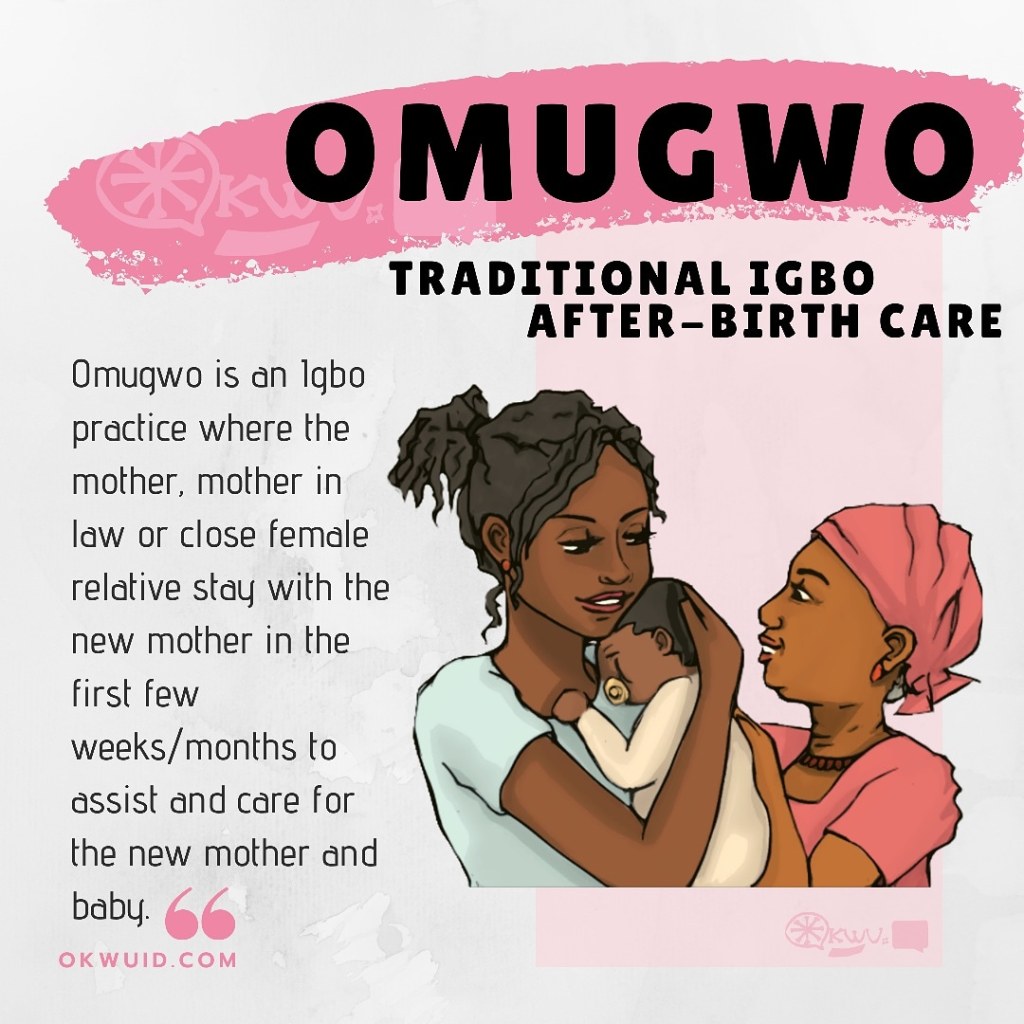
Postnatal care of mother and child by either the mother or mother-in-law of the new mother is a traditional African concept and usually lasts a minimum of three months during which time, the new mother is gradually transitioned into caring for the baby while allowed to regain her strength. The term “omugwo” though the igbo word describing the concept, has become widely used generically, across various other groups in Nigeria. However, with the increasing number of migrants, it is becoming increasingly challenging for both the new mother and the parents to effectively execute this post natal role. There is no one fit solution and mothers expected to play the “omugwo” role must apply wisdom and understanding depending on their unique circumstance.

To all the grandmoms and potential grandmoms out there, Havilah says…have a fulfilling “omugwo.”

Love

Havilah

OLD WIVES’ TALES

It was the responsibility of Modinot to sweep the house and despite the urgings of her older sister – Ramota, she had ignored her chores, playing games with her friends. Suddenly, she looked up and noticed it was almost 8p.m and the house was unswept. Her mother was bound to be back in the next hour. Modinot picked up the broom and rushed through the house like a hurricane. Her mother would be furious if she met the house in that state and she knew she lacked any form of alibi in her sister-Ramota. She would receive the full brunt of her mother’s anger, which could be brutal. As she swept hurriedly, Ramota kept singing in her ears…”Stop sweeping Modinot it is night and Maami has always told us that sweeping at night is a taboo. It brings bad luck.” An argument ensued between the siblings but needless to say, Modinot continued with her task so that by the time Mother returned home, the house was clean. Ramota however reported Modinot’s misdeed to their mother. “Maami, she started, Modinot has just swept the house and you know you always instruct us not to sweep at night as it will attract bad luck.”

Maami , nodded her head and smiled,  “Actually, the story about sweeping at night attracting bad luck can be considered an old wives’ tale” but she went ahead to admonish Modinot and reprimand her for her actions.

After profuse apologies and undertakings on the part of Modinot, she summoned the courage to ask Maami, why nocturnal sweeping could be thought to attract bad luck.

Maami went on to explain as follows: “I will start with an explanation of “Old wives’ tales” and then explain the specific one about nocturnal sweeping and touch on other examples for you to understand fully. Meta AI defines old wives’ tales as those traditional stories, legends, or superstitions, passed down through generations, often containing folk wisdom, myths, or unproven claims. They frequently relate to health, relationships, weather, or everyday life. I remember when I was heavy with your pregnancy and visited my mother, she forbade me to go out of the house in the afternoon without attaching a pin or needle to my clothing, to ward off the evil spirits that roam about in the afternoon. “ Maami laughed and continued. “She believed that the sharp object would prevent miscarriage by cutting off every negative energy that could cause miscarriage and ensure safe delivery. Mind you, there is no scientific basis for this reasoning,  but it is borne out of a desire to protect pregnant women and their children from harm by repelling evil spirits and keeping them from the effects of the intensity of the sun. “

“Now to your specific question. In our culture, nocturnal sweeping is believed to attract ill luck with the following explanations –

  • Spiritually, it is believed that ancestors and spirits are active in the night, so sweeping at that time may disturb or anger them, leading to misfortunes in such homes.
  • Symbolically, sweeping away dirt at night may sweep away prosperity and good fortune from the home.
  • Practically, it stirs up dust making vision and breathing difficult thereby causing illness and health complications. This is because at night, people tend to be in the environment and end up inhaling the dust.”

Undoubtedly, Old wives’ tales vary by society/community although some are more generic. Whichever tales we come across, there certainly are some learning points and/or truths involved that would benefit sections of society. We should therefore try to understand the reasoning behind such tale and not throw away the baby with the bathwater.

Havilah feels intrigued by some of these tales and would appreciate comments and possibly more content on this topic. Do you have Old wives’ tales to share/ I am all ears?

Love

Havilah