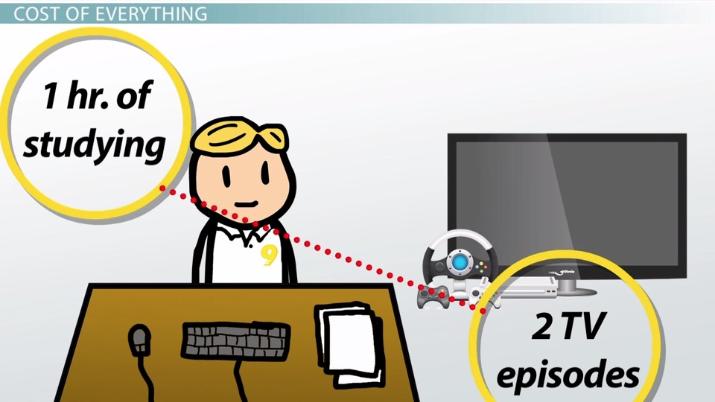
All through life, one thing is certain: there will always be choices to be made as different opportunities arise, offering options and alternatives. An economic concept that readily comes to mind that serves as a guide to decision-making is that of OPPORTUNITY COST. In simple terms, opportunity cost can be described as the value that a person forfeits by choosing one course of action over another. It usually involves both time and money and is present for every decision that is made. Alternatives and options are always present, and it is important to weigh the opportunity cost in making decisions. e.g., I was privy to the decision of a mother to finance her son’s university education abroad at the cost of purchasing a property in a prime location in her country. It was a choice based on her priority, after consideration of the opportunity cost of either option.
I was recently invited to mediate in a conversation between Mr. Babalola and his son, Derrick. Derrick had recently completed his National Youth Service, and his father, who ran a grocery store, had offered him the opportunity to manage the business with the promise of accommodation and a car attached to the offer. Derrick, however, had his sights set elsewhere. He had recently attended an Interview with a Multinational Tech company and was certain he would get the position of a Management Trainee. Though he would have to relocate to another city, the offer would provide him with the opportunity of extensive training and travel. It would, however, mean that Derrick would have to share a rented apartment with a friend and commute to and from work by public transport. The father prevailed on him to weigh the opportunity cost of rejecting his offer, especially in the light of succession to the business.
Derrick weighed the opportunity costs and decided that the opportunity cost of passing up an offer with that multinational corporation was, to say the least, “humongous.” He knew so many of his peers who would give anything for such an opportunity. He projected that the training and experience to be gleaned would catapult him into a league in corporate dynamics, far beyond the management of his father’s retail business, and he was ready to forego the immediate attraction of comfort for the perceived long-term gains. Besides, he opined, the training, experience, and network gained would be of futuristic benefit to his father’s business if he decided to return to it in the future. Following up, Derrick got the offer letter and moved on with his decision.
The importance of discussions like this, especially with teenagers and young adults, cannot be understated. Every day, choices are made, and options need to be weighed carefully in relation to one’s objectives. The opportunity cost of a choice is what is lost by not going with the alternative. I have seen some interesting choices made where a mother would rather owe on school fees and use the money for aso-ebi to the detriment of the child who was kicked out of school for default in fees. Also, the choice of material possessions over qualitative education.” After all, a school is a school, quality of education notwithstanding,” some would say.
I recall my discussion with a young man who said that when he gained admission to the university, his father never lectured him against joining cults but merely pointed out the opportunity cost of cultism versus concentrating on his studies, and that nailed it for him. He could be a cultist gaining popularity and notoriety, with the likely outcome of rustication, or face his studies squarely and achieve recognition through outstanding success, which opens doors for mouth-watering opportunities.
It is my prayer that we exhibit wisdom in our choices and teach the coming generations how to weigh their choices to enable them to make the right choices.
Love
Havilah

 Havilah Speaks