Last week I went with a friend, Nkoli to visit Aunt Ndidi, (Nkoli’s mum and a particularly good friend of my late mother). Aunty Ndidi at 89, looks vibrant and well looked after and I was happy to see her after quite some time. We had a wonderful conversation as she was in high spirits reliving her youth and some of the events in the country at the time. Although Nkoli had earlier warned me that Aunt Ndidi may not recognise me I was pleasantly surprised that she did and immediately asked about her old friend, my mother. I immediately reminded her that mom had passed about 5 years before and that she, Aunt Ndidi had been involved in the funeral arrangements, for which I am eternally grateful. She however continued to request that I ask her to see her and that they probably would visit another of their mutual friends to which I played along as nudged by Nkoli. I ended with,” I will bring her over soon. We will arrange it …Nkoli and I.” I assumed the memory of the loss of her friend was too much for her to process and decided to change the subject matter as I asked what she had for lunch. Her response left me speechless…” My daughter, I have not eaten anything today” she replied. It was already 4 pm and I searched for what to say, I caught hold of Nkoli’s wink and quickly followed her into the adjoining room. We barely entered the room before I whispered “Nkoli, what is going on” to which she replied “Havilah, hmm…Mama was recently diagnosed with Alzheimer’s disease which affects her cognitive abilities. Her memory and some other brain-related functionalities are impaired.”
I took a deep breath and recalled that another friend’s dad 10 years ago was miraculously brought back home by a good Samaritan who recognised him, after wandering around for 24 hours. He was thoroughly, dehydrated, dishevelled, and hungry. He had left home unaccompanied and unannounced the previous day, ostensibly to take a walk. Somehow, he had lost track of place and time and could not find his way home. It was later discovered that he had dementia at the age of seventy-four! I remember thinking then, this is scary.
The more I pondered the subject of dementia and its attendant impact, especially on the loved ones who are closely related or affiliated with the patient, the more I purposed to research this increasingly prevalent condition for the purpose of awareness. The below summation on the subject is culled from Mayoclinic.org:
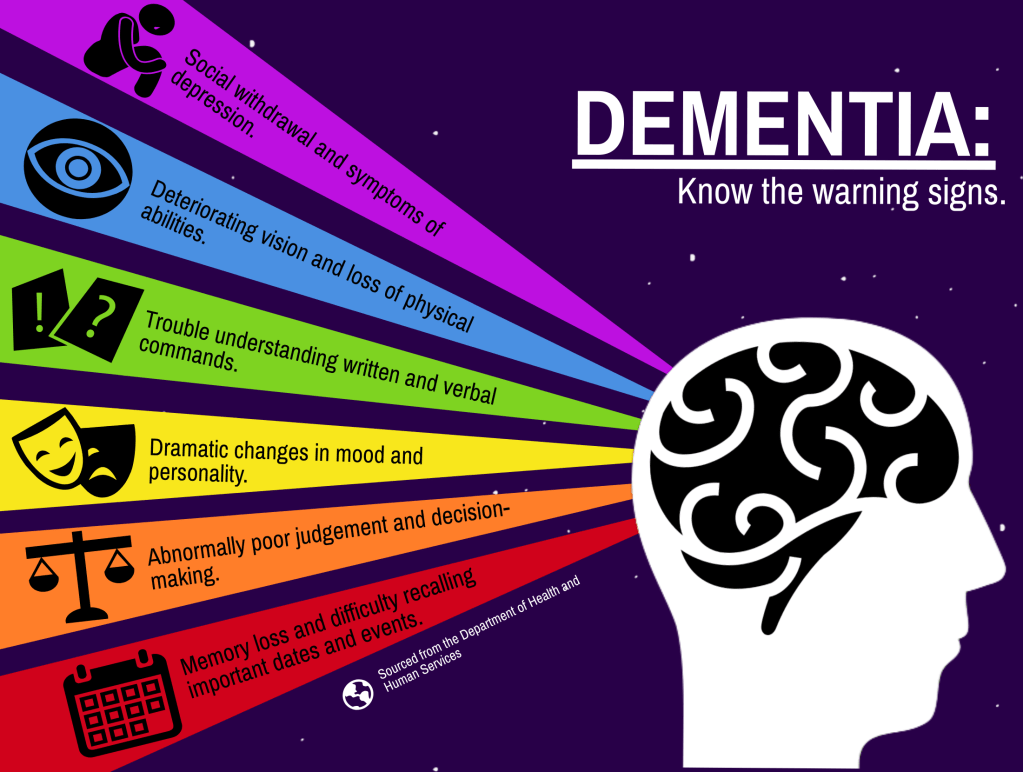
Dementia is caused by damage to or loss of nerve cells and their connection to the brain. Though dementia is not a part of normal aging, the chances of developing dementia increase with age, especially after age 65. However, younger onset dementia may occur in younger persons even as early as 30 years. The condition results in impaired cognitive abilities or difficulty in making decisions that interfere with everyday activities. Early signs of dementia are memory loss, difficulty in concentrating, difficulty with familiar daily tasks, struggling to follow conversations or find the right words, being confused about place or time, and mood changes, among others. While there is no known cure for dementia, the symptoms are dependent on the area of the brain that is affected. Dementia can however be corrected where the damage is caused by deficiency in certain vitamins and minerals. In such cases, treatment is possible. It is therefore important to take vitamin and mineral supplements as we age, in order to make up for deficiencies that may arise from diet.
Dementia is considered a degenerative disease and may be linked to changes in some genes which can be discovered through testing. Three of the more common forms of dementia are mentioned below:
- Alzheimer’s which is the most common. This can be inherited. It is genetic.
- Vascular which is caused by damage to blood vessels supplying the brain. It impacts problem-solving, slowed thinking, and loss of focus and organisation.
- Lewy body dementia which involves acting out dreams in sleep, visual hallucinations, tremors, uncoordinated slow movements, and stiffness (Parkinsonism).
RISK FACTORS THAT CAN NOT BE CHANGED ARE:
- Age – usually above 65
- Family history. However, people with a family history may never develop symptoms and vice versa.
- Down syndrome usually experiences early-onset dementia.
RISK FACTORS THAT YOU CAN CHANGE
- Unhealthy lifestyle. A healthy lifestyle involving a diet rich in nuts, seeds, whole grains, fish, oils, and exercise can lower the risk of cognitive decline.
- Drinking substantial amounts of alcohol. Reduction in alcohol consumption can reduce the risk which is associated with consuming substantial amounts of alcohol.
- Cardiovascular risk factors e.g. obesity, high blood pressure, high cholesterol, diabetes, atherosclerosis, and smoking. Treatment and stoppage of smoking can address the risk.
- Late life depression.
- Air pollution from exhausts and burning wood.
- Head trauma from injury, Sleep problems and disturbances, Low levels of vitamins and minerals especially vitamins D, B-6, B-12, folate etc.
It is therefore important to pay attention to our health as we advance in age to enable graceful aging and to commit the process into the hands of our God.
Love
Havillah
 Havilah Speaks
Very informative. Thank you for the knowledge shared.
LikeLike