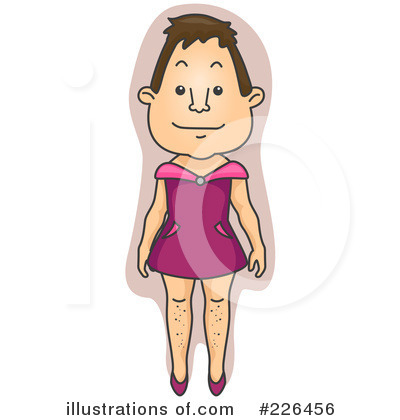
I was at a hairdressing salon recently and the topical discussion centered on a notorious cross-dresser who happens to be a” social media influencer.” As the debate about his/her activities and the social impact raged, several questions preyed on my mind. I intend to share them with you here with the hope of us addressing our mind to the full implications of encouraging such persons in our society.
Who is a Crossdresser, and does s/he differ from the age-old Transvestite?
Is Crossdressing merely a fad or does it affect the person’s psyche such that he/she believes they are members of a different sex?
Do cross-dressers get married and if yes, is the partner the same sex or a different sex?
Is a cross-dresser necessarily a gay person?
How did they get there? Were certain childhood experiences responsible and did they exhibit such preferences in childhood?
What is their relationship with their parents, siblings, and extended family?
How have their choices impacted their family in their communities/environment?
We usually discuss male cross-dressers, are there female cross-dressers and if yes, why are they less visible?
So, what precisely is Cross Dressing? The MSD Manual (Consumer Version) carries an article by George R. Brown, MD, East Tennessee State University from which I extract the following excerpts.
“Most cross-dressers do not have a Psychiatric disorder. They may be said to have transvestism. In transvestism (cross-dressing), men prefer to wear women’s clothing, or, far less commonly, women prefer to wear men’s clothing. This may be because women have a broader range of apparel considered consistent with gender. However, they do not have an inner sense of belonging to the opposite sex or wish to change their sex. The term cross-dressers is usually used to refer to people with transvestism. Transvestite is a less acceptable term and is considered offensive. Cross-dressing in and of itself is not considered a mental health disorder. Cross-dressing occurs in both heterosexual and homosexual men, and much more uncommonly in women. Nonbinary people who dress in clothing typically associated with a different birth sex are generally not engaging in “cross-dressing” for the purposes of sexual arousal. They probably associate themselves with the opposite sex.
Heterosexual males who dress in women’s clothing typically begin such behavior in late childhood. This behavior is associated, at least initially, with intense sexual arousal.
Cross-dressers may, however, cross-dress for reasons other than sexual stimulation—for example, to reduce anxiety, to relax, or, in the case of male cross-dressers, to experiment with the feminine side of their otherwise male personalities.
Later in life (sometimes in their 50s or 60s), some men who were cross-dressers only in their teens and twenties develop gender dysphoria. They may seek to change their body through hormones and genital (gender-affirming) surgery.
When a partner is cooperative, cross-dressing may not hurt a couple’s sexual relationship. In such cases, cross-dressing men may engage in sexual activity in partial or full feminine attire with the consent of their partner.
When a partner is not cooperative, cross-dressers may feel anxious, depressed, guilty, and ashamed about their desire to cross-dress. In response to these feelings, these men often purge their wardrobe of female clothing. This purging may be followed by additional cycles of accumulating female clothes, wigs, and makeup, with more feelings of guilt and shame, followed by more purges”.
While the above may not adequately address all our questions, it gives some insight about Cross-dressers and stimulates our thoughts. Unfortunately, social media serves as a sphere of influence over our youth and there is so much exposure regarding cross–dressing. There is also a growing fad for men to wear jewelry, braid their hair, etc while ladies wear masculine cuts. This in itself does not amount to cross-dressing…what do we think?
Love
Havilah
 Havilah Speaks
Great, read but I would love to add my opinions on the topic.
I do not necessarily agree with females cross-dressing into male clothing being less common to that of male.
In fact I believe it is a lot more common, it has just become so normalized that we don’t see it as cross dressing again. We see women put on shirts, trousers, shorts even traditional wear that are conventional to men but it isn’t regarded as cross dressing anymore.
Whereas for men, it is very easy to pinpoint a man putting on a skirt, a blouse or even a “female jean”.
LikeLiked by 1 person
speaking from the perspective of one with limited acquaintance with cross dressers of either gender. My personal opinion is that society still is some way off from accepting cross dressing as the norm and a usual occurrence. On balance my opinion is that maybe “male” garb is more accepted as unisex and “female” wear less so for males. More conservative persons may accept males in conservative female wear including female shoes and hairdos who are in the modelling, influencer, film or other entertainment industry as justifiable reason for what conservative society will perceive as an unorthodox dressing code . Society at large is still highly conservative even in the western world and individuals in normal walks of life who decide to cross dress do run the risk of being “othered” and marginalised from areas of usual society important for social inclusion and their mental health.
LikeLike
Hmm…true talk
LikeLike